




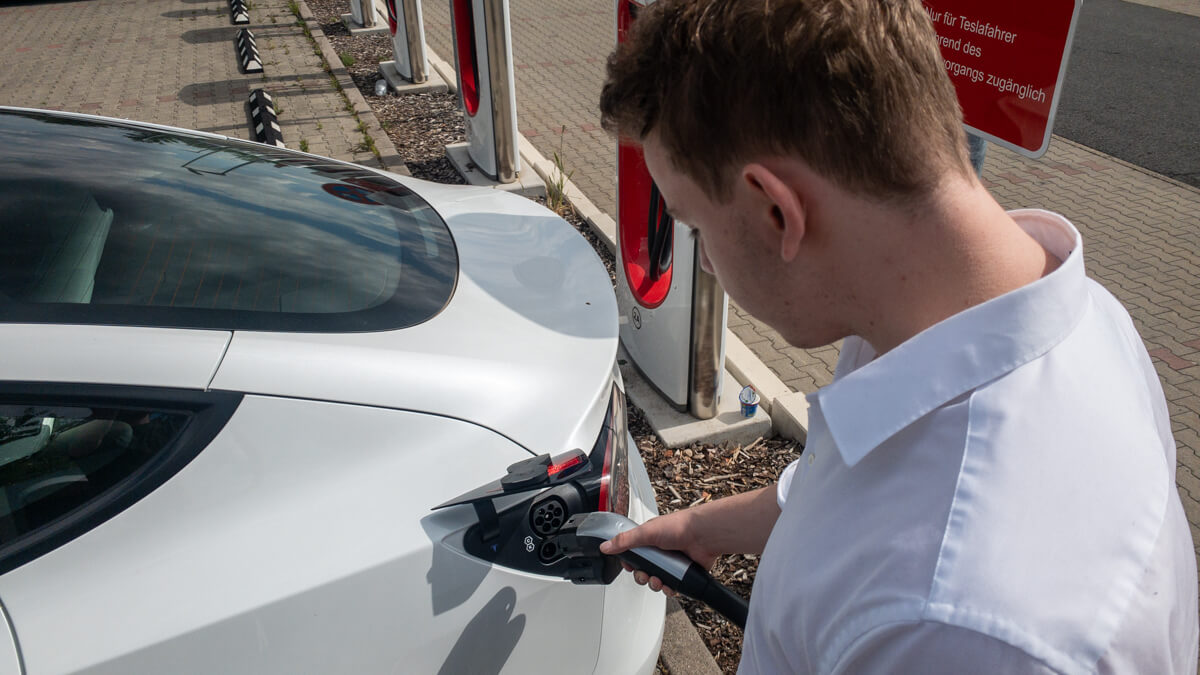
Charging is an essential process for Teslas. At the same time, it remains a controversial aspect, fueled by persistent prejudices that deter many from buying an electric car. Therefore, manufacturers can leverage this aspect to distinguish themselves and win over potential customers by demonstrating strong charging performance and seamless processes.
Tesla has been at the forefront for years with its Supercharger network, offering its customers an excellent charging experience.
However, there are a few things Tesla drivers should be aware of. That's why we've put together this charging guide for you. Using the most popular Tesla, the Model 3, as an example, we'll explain everything you need to know about charging.
Tesla Model 3: Charging performance

All Model 3 specifications can be charged at a wallbox (or other AC charging systems) with a maximum of 11 kW; charging at 22 kW is therefore not currently possible.
Fast charging at the Supercharger with direct current works with a maximum of 170 kW in the basic version, and with a maximum of 250 kW in the more expensive versions – provided you can find one of the newer charging stations that support such charging capacities.
If you charge at home using a household socket, you can also regulate the amperage at which the device is charged.
Tesla Model 3: Calculate charging time
Based on these values, you can calculate a rough charging time yourself. Simply divide the battery size by the available charging power. For example, the currently sold base Model 3 (2022) with a 62 kWh battery will take approximately 5 hours and 38 minutes to charge using an 11 kW wallbox, or 22 minutes with a continuous 170 kW fast charger.
Especially with fast charging, these are only approximate guidelines, as the maximum charging power can only be kept reasonably constant under ideal conditions, and heat losses are not taken into account. Therefore, the times calculated by the on-board computer are never 100% accurate – but they are close.
How far should you charge the Model 3?
You'll rarely need to charge the battery fully from 0 to 100 percent anyway. Besides the fact that you should never completely drain the Model 3's battery, it's also harmful to fully charge it every time. Therefore, you should only use the full capacity for long trips and otherwise try to keep the charge level between 10–20% and 80–90%.
Attention: This only applies to Model 3 vehicles that do not have the new LFP (Lithium Iron Phosphate) battery – this type of battery should be regularly charged to 100%. A maximum charge level can also be set in the Model 3's settings menu, so you can safely leave the cable plugged in.
Tesla Model 3: Charging cable included

Speaking of cables: What exactly is included with the Model 3? For years, Tesla supplied the so-called Mobile Connector and a Type 2 cable. The former is a cable that allows you to charge at any standard 230V household outlet with a maximum of 3 kW. – So it's a kind of stopgap solution. The "Gen 2 Mobile Connector" has not been included in the standard package since April 2022 and must be purchased separately from Tesla.
The Type 2 cable allows you to connect to all types of public charging stations if no cable is available. However, charging is still quite slow, with a maximum speed of 11 kW. Therefore, you will most likely want to use a fast Supercharger, which is already equipped with cables, or charge at home overnight using a wallbox.

Also missing from the scope of delivery is a cover for the charging port.This prevents dirt, dust, and rain from entering the charging port and causing damage. You can find a suitable one at Teslabs. Charging port cover for Model 3/Y.
Charging planning for longer journeys
Driving to work every morning with a full battery is simply wonderful. But what if you want to take your Model 3 on vacation and the route exceeds its maximum range? How do you best plan your charging stops?
The answer is: Not at all! You let the Tesla's navigation system handle such tasks, planning the route and perfectly integrating charging breaks. You can even specify how much battery charge you want to have when you arrive – so why do the heavy lifting yourself?
Charging the Model 3 at public charging stations

The only situation where this would be necessary is if you want to use a public charging station other than a Supercharger – for example, at a hotel or a motorway service area. The Model 3's navigation system also takes these stations into account. It displays not only Superchargers, but also charging stations from other manufacturers such as Ionity or EnBW.
Nevertheless, and this is one of the advantages of Tesla, charging is of course possible there, whereas so far you only have to share the Superchargers with other Tesla customers.
How much does charging cost with the Model 3?
Even though the Tesla plans the charging stops and assists with the drive there, you still have to pay yourself. The days of free Supercharger use for Tesla customers are over.
Currently, charging at Tesla's charging stations costs between 56 and 58 cents per kilowatt-hour. Multiplying this by the maximum battery capacity of the Model 3 (between 52 and 82 kWh, depending on the version and production year) results in costs of €29.12 to €47.56 for a full charge – still significantly cheaper than an average combustion engine vehicle today.
Those who charge at home currently pay an average of 36–40 cents per kilowatt hour, depending on their electricity tariff. And if electricity from a private solar panel can be used, then the Model 3 could almost be described as dirt cheap to run.
Supercharger or wallbox? Which is gentler?
Charging at home is not only more convenient and cheaper, but also generally gentler on the battery. While the high charging currents at fast-charging stations allow you to get back on the road quickly, they are not ideal for the Model 3's battery.
Frequent charging, however, is not as harmful as one might think. Ideally, you should charge at home every evening using a wallbox to 80 or 90% (official Tesla recommendation) and only use Superchargers when needed and for longer journeys.
Can I charge a Tesla Model 3 at a wall socket?
A wallbox can be expensive to purchase. However, trying to save on these costs and charging via the included mobile connector at a standard household outlet is not a good idea.
While the maximum possible charging power of 3 kW is very gentle on the battery, the losses due to the enormous charging time of up to a day are also quite high – both in terms of time and energy. In addition, there is the fire risk from the continuous strain on the electrical wiring, which is not designed for such high loads. Charging at a wall socket should therefore always be a last resort.
The money spent on a wallbox is, in most cases, a worthwhile investment. After all, only by being able to charge quickly and safely at home can you get the full Tesla experience from your Model 3.
Did this article help you? Feel free to share your experience in a comment. If you would like to learn more about this topic, we recommend our 5 tips for a perfect charging experience.