
Life in Germany is becoming more expensive, and this is especially true when it comes to energy. Save, save, saveWhile gas and gasoline have so far been the main focus of public attention, significant price increases for electricity are slowly but surely on the horizon. This will hit Tesla drivers particularly hard, since a single battery charge often corresponds to the consumption of a single-family home for several weeks.
The view of the charging station is unlikely to be pleasant in the near future. Especially if you don't have a solar panel to compensate for the effect.
Just like for drivers of combustion engine vehicles, economical driving and preserving range are paramount for electric car owners. But how exactly is this achieved? What measures truly help to noticeably reduce consumption and the number of visits to the charging station?
In this article, we will give you numerous tips on how to increase your Tesla range and thus save real money.
Current Supercharger prices: Significant increase
The price increase has already taken effect at Tesla's Supercharger stations. Electricity now costs between 69 and 71 cents per kilowatt-hour there, an increase of almost 23 percent compared to the previous prices. which have themselves been increased several times recently.
A full charge therefore costs between €42 (base Model 3) and €70 (Model S/X), depending on the Tesla battery capacity. Compared to refueling a combustion engine vehicle, these are still acceptable figures, but the price increase is noticeable.
Save Tesla electricity: Our 21 best tips
So how do you save energy? Well, consumption and range depend largely on environmental factors such as temperature, road conditions, weather, and traffic. But some tips apply regardless:
Save electricity in your Tesla: Drive defensively
If you want to increase your Tesla's range, you should first and foremost pay close attention to your driving style. The goal is to drive as smoothly as possible with as few acceleration phases as possible. Due to inertia, it is significantly easier and therefore more efficient to maintain a vehicle's speed than to accelerate.
For this reason, drive defensively and anticipate traffic, and avoid stop-start situations whenever possible. To give just one example: it's more economical to cruise steadily at 40 km/h through heavy traffic than to constantly fluctuate between 50 and 30 km/h. If you do need to brake, for example at a red light, release the accelerator pedal as early as possible and let the regenerative braking system do the work.
And when you accelerate again, take your time – going from 0 to 100 km/h in a few seconds is fun, but it consumes a lot of energy. If possible, try accelerating downhill and then simply maintaining that speed.
“Activate "casual" mode
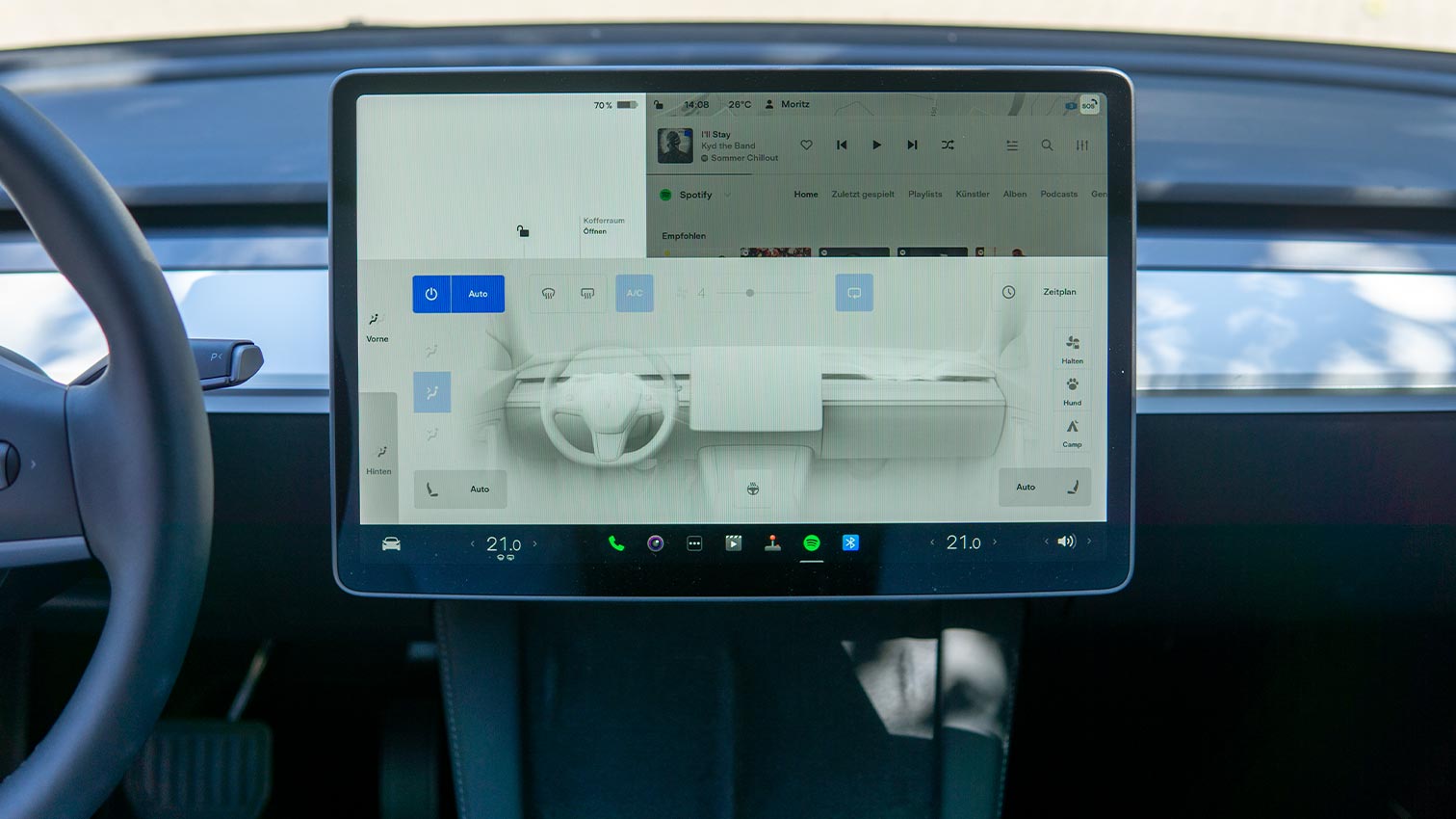
To avoid the temptation of hard acceleration altogether, activate "Relaxed" mode in your Tesla. You can find this under Vehicle -> pedals & Steering -> Acceleration. It reduces power and torque during acceleration, thus automatically resulting in lower fuel consumption compared to the standard mode. While the mode is activated, the word "Casual" is displayed above the speedometer.
Avoid high speeds
To save energy on long journeys, set yourself a speed limit on the motorway. A vehicle's air resistance, and therefore its fuel consumption, increases quadratically with speed, not linearly.So, if you drive at 200 km/h, you don't need twice as much energy as at 100 km/h, but four times as much. Therefore, unfortunately, speeds above 120 km/h aren't really possible for truly energy-efficient driving – and 100 km/h is significantly better.
On the other hand, you shouldn't become a traffic obstruction, of course. Therefore, drive at a speed that allows you to comfortably manage the given traffic situation, but no faster. You'll be surprised how economical a Tesla can be at moderate speeds. And contrary to some fears, this technology doesn't actually make your journeys longer. Especially in heavy traffic, speeds above 130 km/h can't be maintained for long anyway.
Use autopilot/cruise control
As mentioned, a consistent driving style is key to low fuel consumption – and computers are simply much better at doing things consistently than we humans are. Therefore, use your Tesla's autopilot or cruise control.
This is particularly worthwhile on highways and longer stretches of country roads. If you drive on the highway for a while using Autopilot at 100–120 km/h, you have a good chance of getting very close to your Tesla's stated range.
Avoid short trips
Every time you drive, your Tesla needs to bring the battery up to operating temperature, which requires energy. If the trip ends after only a short time, this doesn't exactly contribute to greater efficiency – quite the opposite. Therefore, for short distances, switch to a bicycle whenever possible, or combine several trips. This naturally requires a bit more planning, but ultimately you'll save battery capacity and therefore money.
Avoid mountain ascents
If your route planning allows you to choose, avoid routes that go over mountains or have many curves. Such routes are suboptimal for fuel consumption because they involve frequent braking and acceleration and require significant effort to move the heavy vehicle uphill. Therefore, it's better to take the route where you can drive smoothly and evenly, even if it's only a few kilometers longer.
Recuperation on standard
If the regenerative braking strength is adjustable in your Tesla model, leave it in the standard mode. This way you get the maximum amount of energy back into the battery and, as a nice side effect, you can also drive (almost) entirely with the accelerator pedal.
Check tire pressure
Check your tire pressure regularly. This not only ensures safety but also saves energy: If the tire pressure does not reach the prescribed value, rolling resistance and therefore fuel consumption increase.
Reduce load
Remove all cargo from the vehicle that you don't need for the trip. The greater the weight of your Tesla, the higher the energy consumption, as a greater mass needs to be accelerated.
Optimize aerodynamics
For electric cars, minimizing air resistance is one of the most important factors for maximum efficiency. It's no coincidence that Tesla vehicles are among the most aerodynamic models on the entire automotive market. To further optimize aerodynamics, remove unnecessary attachments such as roof racks or roof boxes, set the air suspension to "low," and use aero wheel covers if available.
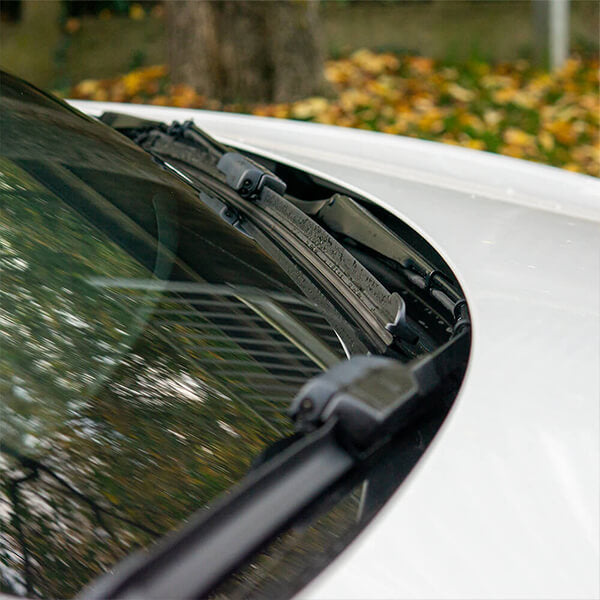
Keep the windows closed while driving. Also, the Teslabs roof window seals They contribute to improved aerodynamics – and also make the ride noticeably quieter.
Protecting Tesla battery: Charging behavior
Besides driving style and equipment, there are many things you can do right when charging. To protect the Tesla battery and extend its lifespan, charge daily and whenever possible at a low power level (i.e., 1/4 of the maximum charging power). B. to (At home, use a wallbox or regular outlet). Only use a Supercharger if absolutely necessary. – Charging at home is usually cheaper anyway.
Pay attention to charging limits
For most Tesla models (except newer base models with LFP batteries), it's advisable to set a charging limit of 90% for everyday use and not let the battery level drop below 20%. You should only charge your Tesla to 100% if you actually need the maximum range. If you do, try to drive off shortly after reaching 100% – keeping the battery fully charged for too long can damage it.
Turn off unnecessary functions
While constantly active monitoring functions like the guard mode or overheating protection don't use much energy, they can of course still be switched off when not in use. Every little bit helps!
Use the energy app
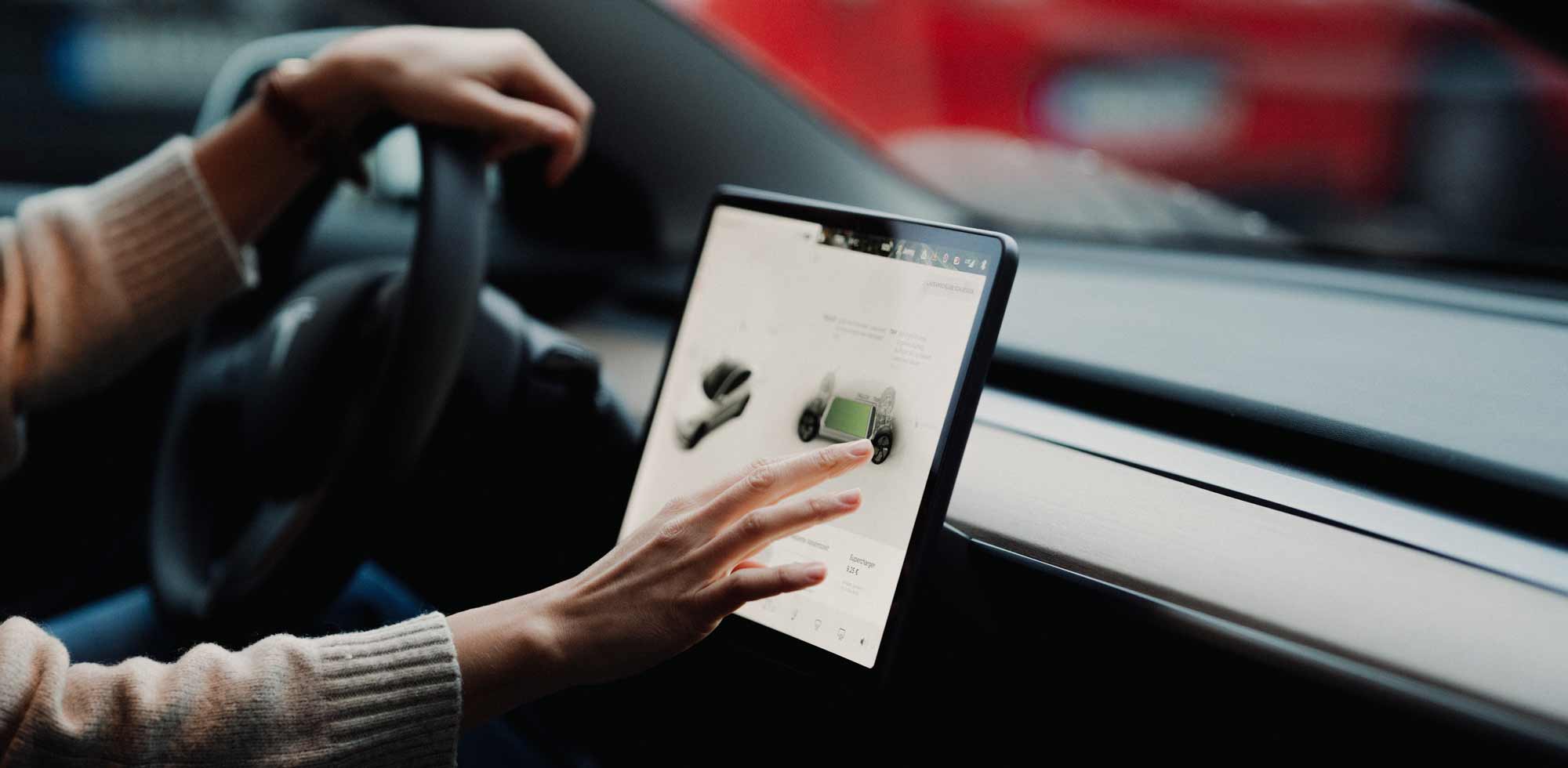
You can access the Energy app via the app menu on your Tesla's touchscreen. This app displays your vehicle's energy consumption over the last few kilometers and calculates a range estimate based on your current driving style and environmental conditions. This range estimate may differ from the one displayed next to the battery icon.
Use the app to check which behaviors were particularly energy-saving and where there is still potential for optimization.
Tesla range in winter: Saving tips
In winter, the low temperatures, which put a strain on the battery, and the high rolling resistance caused by snow and slush make it particularly difficult to get much range out of a Tesla. Here are some tips to help you still make the most of it.
Leave Tesla plugged in during winter
If possible, leave your Tesla plugged in while parked. This ensures that electrical systems like the onboard computer, which are constantly active, are supplied with charging current and don't have to draw power from the battery. Additionally, this helps the battery retain some residual heat and prevents it from cooling down completely.
Park in the garage
If possible, always park your Tesla in a garage during the winter so it doesn't get the full force of the cold nights. This not only saves energy for defrosting the windows in the morning, but also keeps the battery relatively warm.
Precondition before the ride
Even if your battery isn't completely cold due to being parked in a garage, let your Tesla pre-warm the battery before driving off. A warm battery significantly improves efficiency. You can easily start pre-conditioning via the Tesla app. If possible, ensure the vehicle is plugged in during the warm-up process to utilize the charging current for heating.
Alternatively, you can use the "Scheduled Departure Time" function in the app. Here, you specify a time at which you want to leave, and your Tesla will start preconditioning in time. The charging management system also ensures that the battery is fully charged to the specified charging limit by the departure time.
Always program the Supercharger location into the navigation system.
If you plan to charge at a Supercharger, always enter it as a (stop) destination in the navigation system, even if you know the way. This ensures that your Tesla preheats the battery to the ideal charging temperature in time.This makes the charging process faster and with less loss.
Reduce the use of air conditioning
Few things require more energy than heating large volumes of air. This isn't a problem for combustion engines, as the air conditioning simply utilizes the engine's waste heat. Electric cars, however, have to heat their interiors at the expense of their valuable driving range.
So consider whether it really needs to be 25 degrees Celsius in your car, or whether a few degrees cooler would suffice. The most energy-efficient solution is to switch off the air conditioning completely and keep warm using only the seat heating – this is significantly more efficient.
Tesla saves electricity in summer
Savings potential exists not only in the cold winter, but also in the summer months. Imagine you're driving to sunny Italy for your vacation and want to get more range out of your Tesla Model 3 to reach your destination with as few charging stops as possible. We'll explain how you can drive as economically as possible in the heat.
Air conditioning – again?
Yes, even in summer, the air conditioning is a significant factor in saving energy. Just like with heating, the energy used for cooling the air is drawn from the battery and is then no longer available for driving. Therefore, try not to turn your Tesla into a refrigerator, even if it's an unbearable 40°C outside. Often, simply opening all the doors before getting in and letting the hot air escape is enough. If you can spare a few minutes for this, you can save a considerable amount of energy.
However, it's worth noting that air conditioning isn't always the worst option. Using it – except when driving slowly – is still better than lowering the window.
Use sunscreen to stay ahead of the heat
The best solution in summer, however, is to prevent the vehicle interior from getting too hot in the first place. You can achieve this with Teslabs sun protection products For your Tesla. These protect the windshield and glass roof of your Model Y, 3, S or X from sunlight and keep the interior pleasantly cool.
Conclusion: Saving energy in a Tesla
21 tips – 21 different ways to reduce your Tesla's energy consumption and maximize its range. Ideally, you should apply as many of these tips as you can, although the potential savings will naturally vary considerably from tip to tip. You'll achieve the greatest effect with a more defensive driving style, optimized aerodynamics, and avoiding using the air conditioning.
Use the energy app on the central touchscreen to monitor the success of your efforts. This way, driving remains possible even during times of rising energy prices, leaving you with more money to cover other expenses.
Give it a try – you have nothing to lose.
Source of featured image: myenergi via Unsplash